

The life sciences industry has a difficult energy problem. Pharmaceutical and biotech sites need controlled environments, reliable utilities, and steady production. At the same time, companies need to cut emissions and energy use without affecting product quality or compliance.
That makes net-zero life sciences a practical issue for engineering and operations teams. The work goes beyond renewable electricity. It includes heating, cooling, ventilation, process utilities, building design and supply chain emissions. The 5th Net-Zero Life Sciences Forum 2026 will bring these subjects together in Düsseldorf on 12-13 November 2026. This article looks at the event partners and the work they do across automation, engineering, energy management, materials and building systems.
What is Different in the 5th Net-Zero Life Sciences Forum 2026
The forum looks at net-zero life sciences from the perspective of people who build and run pharmaceutical, biotech, and medical device facilities. That gives the discussion a practical focus. A lower-carbon design still has to meet GMP requirements. It also has to keep production reliable.
For example, the agenda covers energy resilience, low-carbon power and facility design. It also looks at retrofits, process decarbonisation and the move from steam to electrification. Scope 3 emissions and CDMO supply chains add another part of the picture. Meanwhile, sessions on CAPEX and investment decisions deal with the cost and risk of making these changes. The programme therefore connects net-zero life sciences goals with everyday engineering, operations and financial decisions.
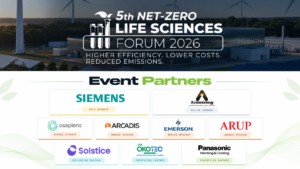
Event Partners: 5th Net-Zero Life Sciences Forum 2026
The companies involved work in different areas. Some focus on automation and facility engineering. Others work with steam, energy data, cooling, materials or supply chain reporting.
Siemens – Gold Sponsor
Siemens develops digital and electrical systems for life sciences facilities. Its portfolio includes automation, building systems, electrical infrastructure, and digital tools. The company also provides digital twins and simulation tools through Siemens Xcelerator.
For pharmaceutical and biotech sites, these tools can help teams examine facility and process performance before making physical changes. In addition, Siemens works on energy efficiency, electrification, and renewable energy integration. Its life sciences offering covers both production systems and the infrastructure around them. The company says its building management approach can help address high energy use in R&D and production facilities. Siemens also supports GMP compliance through software-defined automation and data-driven processes. As a result, its work covers several parts of a facility rather than one isolated system.
Armstrong – Silver Sponsor
Armstrong International works with steam, hot water, heat transfer and other thermal utility systems. Its pharmaceutical offering includes clean steam generation, steam quality monitoring and steam trap solutions.
Steam quality matters in sterile applications. Armstrong’s Steam QM-3 system measures moisture, superheat, and non-condensable gases in steam. The company says the system can help biopharmaceutical facilities monitor steam quality against EN 285 requirements. It also provides wireless monitoring for steam traps. This helps the maintenance team locate bad traps and cut down on steam wastage. Armstrong also offers solutions for heat recovery, humidification and hot water. The systems have an impact on energy consumption in buildings where thermal utilities are running for long durations, as well as in those installations. The firm boasts over a century’s experience in thermal utility systems.
Osapiens – Bronze Sponsor
Osapiens develops software for supply chain management, regulatory compliance and carbon data. Its osapiens HUB brings this information together in one platform, covering areas such as supplier intelligence, carbon management, sustainability reporting and product compliance.
That becomes increasingly important when emissions are not limited to a company’s own sites. Pharmaceutical businesses also need to understand what is happening across their supply chains, from suppliers and materials to other parts of their value chain. osapiens says more than 2,500 companies in over 60 countries use its HUB. Having this information in one place can give teams a clearer view of supplier data, reporting requirements and carbon performance.
Arcadis – Bronze Sponsor
Arcadis works on pharmaceutical and biotechnology facilities, from manufacturing plants and research sites to production expansions. Its services cover design and engineering as well as commissioning, qualification and validation in GMP environments.
Sustainability sits alongside this work rather than being treated as a separate exercise. Arcadis uses whole-life carbon assessments to look at emissions from design through to operation. Its work also considers energy, water, capital investment and operating costs. The company has worked on projects involving cleanrooms, HVAC and utilities, and also uses digital twins to support facility optimisation. For pharmaceutical companies, these considerations can become important when a facility needs to cut emissions without disrupting production or GMP requirements.
Emerson – Bronze Sponsor
Emerson develops automation, measurement and control systems for pharmaceutical and biotechnology manufacturing. Its DeltaV platform is used for process control, production workflows and operational data.
Some of Emerson’s work gets quite specific about where resources are being used. The company uses real-time scheduling to manage cleaning and sterilisation processes and says this can reduce unnecessary steam and water consumption. It also offers automated steam trap monitoring to help identify energy losses. Alongside this, its life sciences portfolio covers process control, equipment health and real-time release. The company works across pharmaceuticals, biologics, vaccines and advanced therapies, putting its technology close to the manufacturing process itself.
Arup – Bronze Sponsor
Arup provides engineering and advisory services for pharmaceutical and biotechnology facilities. Its work includes cleanrooms, cGMP facilities, process utilities and production upgrades.
Energy use can be particularly high in cleanrooms because airflow, temperature, humidity and pressure all need careful control. Arup uses engineering analysis and computational fluid dynamics to examine how these systems perform and where energy savings may be possible. The company has also worked with Pfizer on energy efficiency measures that it says delivered more than $1 million in annual savings. Its work extends to decarbonisation planning too, including carbon mapping and longer-term changes to facility systems. The aim is to consider energy performance as part of the facility design, rather than leave it until later.
Solstice – Presenting Partner
Solstice Advanced Materials develops specialty materials for areas including healthcare and cooling. Two parts of its portfolio are particularly relevant here: Aclar pharmaceutical packaging materials and Solstice refrigerants with lower global warming potential.
Aclar film has been used in pharmaceutical packaging for more than 50 years and provides a high moisture barrier to help protect medicines. Solstice says the material can also reduce pack size, waste, and carbon emissions compared with cold-form foil in certain applications. The company also develops refrigerants with lower global warming potential for cooling systems. That brings another part of the facility into the conversation. Cooling can account for a substantial amount of energy use, particularly in environments where temperature and other conditions have to remain tightly controlled.
ÖKOTEC Energiemanagement – Presenting Partner
ÖKOTEC Energiemanagement provides energy management software and consulting services. Its EnEffCo platform collects energy data and helps companies monitor consumption, costs and emissions.
A project at Bayer’s pharmaceutical plant in Berlin gives a more practical example of this work. ÖKOTEC looked at laboratory ventilation and monitored steam, cooling water, heating water and electricity across four air-handling units. The company reports annual savings of around 18% in energy costs and 27% in CO₂ emissions. Its EnEffReg algorithms helped identify more efficient operating settings and adjust the systems automatically. It is a useful example of what can be found in an existing facility when teams have detailed data on how their equipment is actually running.
Panasonic – Exhibition Partner
Panasonic Heating & Cooling provides HVAC and air-quality systems for commercial and industrial buildings. Its range includes VRF systems, chillers, air-handling units, ventilation equipment and controls.
One of its pharmaceutical examples comes from DDD Pharmaceuticals’ manufacturing and storage facility in Watford, UK. Panasonic supplied an ECOi VRF system for the site, with seven 16kW cooling-only cassettes serving the pharmaceutical area and five additional units providing heating and cooling for offices. The same outdoor units served both requirements. Panasonic reports cooling and heating COP figures of up to 4.04 and 4.56 for the installation. It is a fairly straightforward example of how one HVAC system can serve different areas of a pharmaceutical site while maintaining their separate temperature requirements.
To Sum Up
Net-zero life sciences is about more than switching to renewable electricity. There are plenty of other places where a facility can reduce energy use and emissions. Better ventilation, more efficient heating and cooling, tighter control of utilities and better energy data can all make a difference. The supply chain matters too. Companies need to understand emissions from suppliers and other activities outside their own sites.
The challenge is making these changes work in a pharmaceutical environment. Production still has to run, GMP requirements still apply, & major upgrades have to fit within investment plans. That means net-zero life sciences is not something one team can handle on its own. Engineers, operations teams, sustainability specialists and finance teams all have a part to play.
The 5th Net-Zero Life Sciences Forum 2026 will take place on 12-13 November 2026. It will be at the Crowne Plaza Düsseldorf – Neuss Hotel in Düsseldorf, Germany. The agenda covers:
- Energy resilience,
- Facility design,
- Process decarbonisation,
- Scope 3 supply chains,
- & CAPEX decisions.
Register to attend the forum and discuss practical approaches to net-zero life sciences.