


The UK data centre market is entering a period of major change. AI is increasing demand for computing capacity, while power availability is making site selection more difficult. Planning, cooling, water use and construction capacity are also becoming bigger concerns for developers and operators. A new facility has to deal with all of these issues from the start. The choices made during design can affect construction costs, energy use and how well the site performs later. The 4th Data Centre Design, Engineering & Construction Summit UK will bring these issues into one discussion. This article looks at what makes the event useful and the companies involved.
What is Different in the 4th Data Centre Design, Engineering & Construction Summit UK
The 4th Data Centre Design, Engineering & Construction Summit UK will have a strong focus on the practical side of developing data centres in the UK. The event covers site selection and planning, advanced cooling, construction and supply chains, and commissioning and operational readiness.
That focus fits the current UK market. Developers have to think carefully about grid connections, planning requirements and the availability of suitable sites. At the same time, AI workloads are changing the amount of power and cooling that facilities need. The event also looks at liquid cooling, modular construction, heat reuse and sustainability.
The value for attendees will come from bringing these subjects together. A data centre project does not move through separate boxes where one team handles power, another handles cooling, and someone else deals with construction. Decisions overlap. The people designing the facility need to understand those links early.
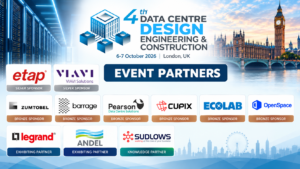
Event Partners: 4th Data Centre Design, Engineering & Construction Summit UK
The event partners will represent companies working across electrical engineering, connectivity, construction, cooling, lighting, skills and other areas that support data centre development.
ETAP – Silver Sponsor
ETAP develops software for electrical power systems. Its products support electrical design, analysis, protection, control and operation. The company also has an Electrical Digital Twin that creates a digital representation of a physical power system. Engineers can use this during different stages of a project, from early design through commissioning and operation.
ETAP has a specific focus on data centres. Its solutions cover power system modelling, short-circuit analysis, load flow, protection coordination and other electrical engineering requirements. It also works with cloud data centres, colocation facilities and other mission-critical sites. As data centres become more power-intensive, having a clear picture of the electrical system becomes increasingly important. ETAP’s software gives engineering teams tools to model that system before and during operation.
VIAVI Solutions – Silver Sponsor
VIAVI Solutions develops test and measurement technology for communications and network infrastructure. Its work includes optical testing, fibre networks, high-speed Ethernet and data centre interconnects. The company provides tools that allow network teams to check whether infrastructure is working as expected before it goes into service and while it is operating.
VIAVI also works on testing for high-speed networks used in AI data centres. That is an area where performance requirements are changing quickly. AI systems can require very high bandwidth between servers, switches and other parts of the infrastructure. Network testing therefore becomes part of the wider engineering job rather than something left until the end. VIAVI provides equipment and software for testing these connections and identifying problems in complex network environments.
Zumtobel – Bronze Sponsor
Zumtobel develops lighting and lighting management systems for professional buildings. Its products include general lighting, emergency lighting and systems that allow building operators to manage lighting across a facility. The company has also developed lighting solutions specifically for data centre environments.
Data centre lighting has some straightforward requirements. Engineers and technicians need enough light to work safely around racks, equipment and service areas. Emergency lighting also needs to work when normal power is unavailable. At the same time, operators want to avoid wasting energy on lighting areas that are not in use. Zumtobel’s data centre solutions combine these requirements with lighting controls and energy management. The company has also supplied lighting for data centre projects in the UK, including the Kao Data campus.
Barrage – Bronze Sponsor
Barrage works across data centre infrastructure, cloud and AI. The company develops and deploys infrastructure for AI and machine learning, Web2 and Web3 environments. Its work includes data centre deployment, commissioning and on-site technical support.
Recent projects on its website include the deployment and commissioning of NVIDIA H200 SuperPOD infrastructure, commissioning work for NVIDIA H100 SuperPOD systems and the deployment of rear-door heat exchangers. Barrage also provides AI and cloud solutions for organisations that need to run AI systems and increase computing capacity. Alongside its infrastructure work, the company develops software and integrates enterprise systems, cloud platforms and applications.
Pearson Data Centre Solutions – Bronze Sponsor
Pearson Data Centre Solutions provides liquid cooling solutions for high-performance data centres. The company supplies components and assemblies for liquid cooling systems, working with Danfoss on fluid conveyance technology. Its services include in-house hose assembly and testing, with strict cleanliness processes for critical cooling applications. Pearson says its manufacturing processes can clean systems down to 6 microns. The company has more than 60 years of engineering and fluid power experience and forms part of the R&G Fluid Power Group and Diploma PLC. Its data centre work focuses on reliable cooling infrastructure for facilities dealing with higher thermal loads and growing computing demands.
Cupix – Bronze Sponsor
Cupix develops digital twin and spatial intelligence technology for construction and the built environment. Its platform can combine 360-degree video, laser scans, drone images and BIM information into a digital view of a physical site. Construction teams can then use that information to see what has been built and compare it with the original design.
This can be useful on large data centre projects, where several contractors and specialist teams may be working at the same time. A detailed visual record gives project teams another way to check progress and keep track of site conditions. Cupix also provides tools for comparing construction progress with schedules and BIM models. The company works with owners, contractors and other organisations involved in construction and facility management.
Ecolab – Bronze Sponsor
Ecolab works with data centres on water and cooling management through its Nalco Water business. Its services cover water treatment, cooling systems, water safety and ongoing system performance. The company works across the data centre lifecycle, from site selection and design to day-to-day operations.
Water has become a more important issue for data centre operators as capacity increases. Cooling systems can require large amounts of water, while higher-density computing creates more heat inside the data hall. Ecolab also works on liquid cooling for high-performance computing environments. That includes technologies aimed at managing cooling performance while keeping an eye on water use and equipment protection. Its work sits at the intersection of cooling, resource management and the operational needs of modern data centres.
OpenSpace – Bronze Sponsor
OpenSpace develops visual intelligence technology for construction. Its platform captures site information using 360-degree cameras, smartphones and drones. The system then connects that information with project plans and other construction data. Teams can use the resulting record to check progress, review completed work and see conditions across a site without relying entirely on written reports.
OpenSpace has developed specific applications for data centre construction. The company says its technology has been used on more than 1,000 data centre projects around the world. It also works with major construction and engineering organisations on large infrastructure projects. On a data centre build, where schedules can move quickly, and several trades can be working in different areas, having a visual record of the site can make it easier to track what has happened and what still needs attention.
Legrand – Exhibiting Partner
Legrand provides infrastructure for data centres across power, cooling, containment, connectivity and physical equipment. Its portfolio includes busbars, transformers, power distribution units, racks, cabinets, cable management, structured cabling and cooling systems. The company also owns or operates specialist brands including Starline, Raritan, Server Technology, Minkels and USystems.
Its data centre products are used across different types of facilities, including edge, colocation and hyperscale sites. Legrand works on both the white space and the supporting infrastructure around it. That covers the equipment housing and power distribution inside the data hall as well as systems that help move power and manage cables throughout the facility. The company says its data centre teams have engineered solutions in more than 170 countries, giving it a broad international presence.
Andel – Exhibiting Partner
Andel develops leak detection and environmental monitoring systems for critical facilities, including data centres. Its Floodline systems detect water, oil and refrigerant gas leaks and can also monitor temperature and humidity. In data centres, Andel’s systems can protect areas such as server halls, underfloor spaces, HVAC equipment, drip trays and generator rooms.
The system can raise alarms, communicate with building management systems and activate automatic shut-off valves when required. Andel has also delivered bespoke Floodline installations across multiple data centres in London and the South East. The company has more than 30 years of experience in leak detection and manufactures its products in the UK.
Sudlows – Knowledge Partner
Sudlows is a UK-based specialist in data centres and critical infrastructure. The company works across the data centre lifecycle, from design and construction to testing, commissioning, maintenance and audits. Its services also cover critical power, cooling and air conditioning, electrical systems, fibre networks, simulation and modelling.
For new projects, Sudlows reviews technical designs and assesses how practical they will be to build. Its engineers also use computational fluid dynamics to study cooling performance before construction starts. The company provides BIM validation, drawing reviews, installation inspections and technical submittal assessments. Sudlows also operates internationally, with work across Europe, the Middle East, Asia, North America and Australia.
To sum up
The 4th Data Centre Design, Engineering & Construction Summit UK will bring together companies working on very different parts of a data centre project. It says something about where the industry is heading. Building a data centre is no longer just about putting servers inside a suitable building. Power, cooling, construction methods, network capacity, monitoring and operational planning all have to work together.
For professionals working in the UK and wider European data centre market, the summit on 6-7th October in London, UK, with this kind of practical focus can be useful. They offer a chance to hear how developers, engineers, operators and technology companies are dealing with real projects and changing requirements. As AI and cloud services continue to increase demand for digital infrastructure, those conversations will become even more important. Register now!