




The 3rd Data Centre Design, Engineering & Construction Summit on 2-3 December 2025 in London, UK, was not about theory. It dealt with real-world pressure, real-world constraints, and the real engineering you have to do to keep up with AI, density, & decarbonisation. Over two intense days, the industry went head-to-head with increasing compute requirements and decreasing tolerance for waste, delay, & inefficiency. What evolved wasn’t any single solution but rather a layered approach. It was established on design discipline, power strategy, community integration, materials innovation, & predictive engineering. So, this article gives a summary of the technical sessions, expert debates, & applied use cases. These influenced the dialogue around sustainability, cooling, construction, AI-driven design, and future-ready infrastructure.
Sessions: 3rd Data Centre Design, Engineering & Construction Summit
The sessions were filled with insane value. We have summarised it for you in this section. This will give you a clear look at the technical content covered by each speaker. Let us go through them:
Designing Sustainable Data Centres: Innovation and Efficiency
Speaker: Ozgur Duzgunoglu, Senior Director, Design & Engineering, Telehouse
The speaker went through how sustainability upgrades reshaped the Telehouse London Docklands campus. Furthermore, the session covered major energy efficiency improvements/modern refurbishment of Telehouse South/chiller replacements with system optimization at Telehouse West. Moreover, the speaker went into details about the sustainable design & construction approach that went behind the Telehouse West Two facility. The discussion put a spotlight on advanced cooling technologies, such as liquid cooling, and how these upgrades make performance with modern sustainability standards fall in line. This is while supporting long-term operations efficiency across a live/mission-critical environment.
Thinking Outside the Hyperscale Box – Rethinking Efficiency, Cost, and Scale in Data Centre Design
Speaker: Anthony Sarno, CEO, ServerChoice
The presenter challenged conventional hyperscale thinking with a vision of tomorrow based on a distributed, modular edge data centre. The session delved into ways in which factory-built modular construction can decrease construction time, capex, & risk. The speaker described how energy has to be part of design through liquid cooling, high-density racks, and heat recapture. This is to lower PUE without runaway cost. The session also discussed staged MW block scalability & circular site selection by making use of repurposed industrial sites and IDNO rebates. This is to cut embodied carbon and speed deployment.
High-Density Cooling for a Sustainable World
Speaker: Tom Bosmans, Business Development Manager EMEIA, BAC
The speaker illustrated the transition from low-density to high-density data centre layouts and the consequent need for new cooling techniques. Moreover, the session followed the development of the traditional air cooling to high-performance liquid cooling. The speaker discussed the challenges associated with sustainability related to carbon, PUE, and WUE for AI & HPC data centres. Using case studies and technology comparisons, the session considered performance, scalability, and environmental solutions. The speaker also spotlighted global alliances, renewable energy-powered facilities, and installations around the world. These solidify the company as a leader in cooling technology.
Designing for Future Flexibility and the Community
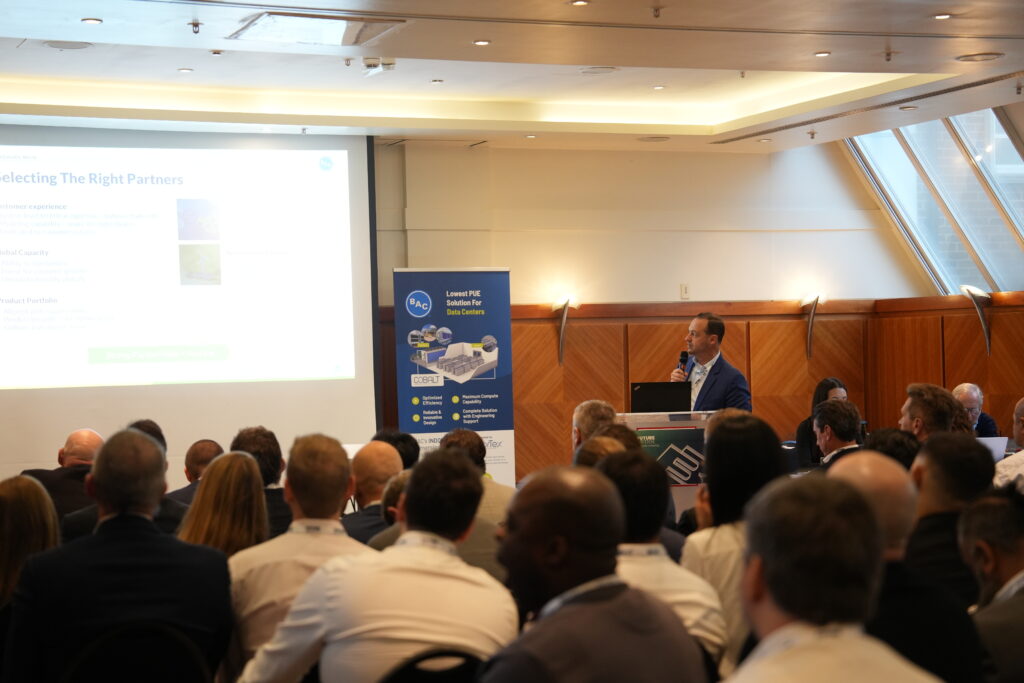
Speaker: Peter Newburn, Head of Engineering, UK, Colt DCS
The presenter looked at the ways in which the building legacies of industry & telecom impact contemporary data centre design. Additionally, the session at the 3rd Data Centre Design, Engineering & Construction Summit highlighted how next-generation architecture is built around flexibility. This is by means of modularization/structural design. The speaker also tied physical adaptability to larger social commitment via community energy sharing and local business involvement. Among other things, the session also tackled the question of design’s effect on community identity. Throughout the talk, the speaker framed flexibility as both an engineering imperative and a mechanism through which data centres could come to reside more comfortably within the communities that house them.
Can the UK and Europe Power an AI Future?
Speaker: Tate Cantrell, Chief Technology Officer, Verne
The speaker framed energy to be the hurdle in future data centre expansion. Furthermore, the session put Europe’s renewable leadership & flexibility in demand-supply in comparison to the US energy market. The speaker underlined how operators can unlock growth without new transmission. This is while speeding up time to market with flexible power methods. Additionally, site selection in areas that are energy-constrained was a key focus of the session. The speaker also showcased how modular design directly leads to speed/adaptability/scalable capacity to meet the demands of the AI infrastructure landscape.
Early Detection: The First Line of Defense Against Data Centre Fires
Speaker: Michael Calvert, Specialist Detection Systems Manager, Protec Fire & Security Group
The presenter described the impact of data centre loss and the growing threats associated with contemporary infrastructure fires. The session demystified the causes of data centre fire events. It also justified the need for the earliest detection. Moreover, the challenges relating to securing high-density/technology-laden environments today were then covered by the speaker. The session was wrapped up with a deep dive into the best early warning detector technologies right now. The emphasis was on how they enhance robustness in mission-critical facilities.
From Water to Warmth: Sustainable Data Centre Design in Action
Speaker: Stephanie Taylor, EVP, Development, Europe, QTS Data Centres
The presenter demonstrated how cooperation between the data centres and the city infrastructure creates real sustainability. The session illustrated how the QTS partnership with WarmteStad makes it possible to transfer heat from the data centre to local heating needs. So, this reduces the energy bills of local citizens. The speaker also discussed the company’s waterless cooling process. It detailed how that impacts the amount of water it saves and what that means for sustainable operations in the long term. Additionally, the session at the 3rd Data Centre Design, Engineering & Construction Summit presented how engineering, community benefits, and responsible resource use are finding common ground in live deployments.
Has Edge found its Market in this Era of AI Inference and Neoclouds?
Speaker: Peter Hannaford, Chief Executive Officer, EdgeNebula
The presenter began by defining edge computing, AI inference, and neoclouds before returning to early edge hype and expectation gaps. Furthermore, the session described what has changed via latency requirements, data gravity, and decentralization. The speaker discussed the exponential increase in inference workloads and why these workloads prefer the edge for cost, privacy, and performance. The session charted out where edge adoption is accelerating in telco, retail, transportation, and healthcare. Additionally, the speaker concluded with security-, orchestration- and standardisation-related challenges, contrasting the futures of edge and cloud.
Solving the HVAC Fluid Trilemma: Innovation in Facility Cooling Fluids
Speaker: Stephen Zhao, Thermal Management Director, EMEA, Castrol ON
The speaker described how fluids have now become critically important in modern data centres, not just for liquid cooling. The session demonstrated how water-based fluids are used in HVAC systems for heat transfer & heat rejection and why innovation is still needed. Moreover, the speaker identified the industry constraint of having to pick only two perks from safety, performance, & freeze protection. Additionally, the session presented a novel fluid solution that achieves ethylene glycol level performance and freeze protection. That too, without the associated safety concerns. So, this brings a new dimension to a longstanding HVAC performance challenge.
How Plastics Solutions Increase Efficiency, Reliability, and Sustainability in Modern Data Centre Infrastructure
Speaker: DI Daniel Fechtig, PhD, Head of Project Business, AGRU – The Plastics Experts
The speaker made the difference between engineering plastics and consumer plastics clear, along with why the difference is important in data centre infrastructure. Furthermore, the session outlined five core reasons engineering plastics improve efficiency in cooling, operational reliability, safety, & sustainability. Moreover, the speaker made a comparison of plastics with traditional construction materials and supported this discussion with major project references. Additionally, the session gave a company overview and went through an explanation as to how the company supports data centre projects. This is with CAD, BIM, FEM, CFD design, specialised products, & installation using advanced welding technologies/ OSM solutions.
PANEL DISCUSSION – AI-Driven Design, Engineering & Construction: Hype or Game Changer?
Moderator: Stephen Zhao, Thermal Management Director, EMEA, Castrol ON
Panelists:
- Peter Hannaford, CEO, EdgeNebula
- Anthony Sarno, CEO, ServerChoice
- Michael Calvert, Specialist Detection Systems Manager, Protec Fire & Security Group
The speakers went into the debate of how AI reshapes design, engineering, & construction across infrastructure that is mission-critical. Furthermore, the discussion went deep into generative design for complex spaces, AI-MEP coordination, & automated clash detection processes. The speakers then examined how predictive construction planning makes an improvement in timelines/risk management. The panel also addressed digital twins powered by real-time data & AI. This is alongside AI-material optimization and sustainability modelling. So, the session made a balance of technological potential with on-ground delivery realities across data centre projects.
Opportunities & Challenges in the EMEA Data Centre Construction Market
Speakers:
- Peter Capplis, GDC Director, Global Commercial Management, Equinix
- Claire Cullen, GDC Director – EMEA, Commercial Management, Equinix
The presenters at the 3rd Data Centre Design, Engineering & Construction Summit gave a walkthrough of the company and the building EMEA data centre pipeline. This session looked at market-scale opportunities, as well as supply chain challenges impacting contractors, consultants, & OFCI vendors. Furthermore, the speakers responded to how commercial execution is now defined by cost pressure, time pressure, & risk exposure. The conversation tied market demand to delivery bottlenecks. It illustrated how the region’s growth continues to strain procurement, construction capacity, and coordination. This is in ever more complex, multi-country development programmes.
BRAINSTORMING SESSION: Breaking the Bottlenecks: Accelerating Data Centre Design, Engineering & Construction in a High-Demand, High-Density Era
This session allowed for an open discussion amongst all attendees to address the key bottlenecks in the delivery of data centres in an increasingly high-demand, high-density market. The conversation centred on actual limitations within design, engineering, and construction workflows. Moreover, attendees looked at how capacity strain, technology complexity, and compressed timelines are converging. The session fostered actionable thinking about teamwork, process efficiency, and speed of execution. By the end, participants found common ground on shared pain points and collective strategies to maintain pace with growing infrastructure needs.
PrīmX® Concrete Technology: Net-Carbon-Negative Concrete Solution for Sustainable Data Centres
Speaker: Artjoms Smirnovs, Head of Marketing and Strategic Accounts, PRIMX
The speaker explained the need for control of shrinkage. This is by contrasting the durability of ancient Roman concrete with the short life of modern concrete. Furthermore, the presentation demonstrated that traditional techniques depend on added thickness and steel reinforcement. This increases CO2 footprint, time, & cost, without actually addressing the underlying cause of deformation. So, the presenter described a concrete technology that prevents deformation due to shrinkage and enables lifetime-flat structures. The solution has been proven to provide over 70 percent reduction in CO2 emissions. It has also led to accelerated construction timelines and minimal maintenance across data centre projects.
It’s Only Waste If You Waste It
Speaker: Matt Craggs, Co-Founder and CTO, Deep Green
The presenter brought urban ecology systems thinking as a novel approach to redefine traditional data centre location selection. Furthermore, the session outlined how heat recovery may change the economics of computing infrastructure. The speaker provided insights into how circularity is built into the heart of community design. He also addressed the practicalities of achieving challenging sustainability objectives. So, the session at the 3rd Data Centre Design, Engineering & Construction Summit transformed waste into a resource, and heat recovery as an environmental/economic ‘lever’ in the context of high-density urban areas.
Data Centre Design in the Age of AI and Hyperscale Computing
Speaker: Richard Collar, Technical Director, Kao Data
The presenter described how the development of the modern data centre is now driven by AI-designed infrastructure. Furthermore, this session demonstrated the application of industrial-scale hyperscale design principles while still operating sustainably. The speaker also discussed mission-critical deployment expertise and how it enables the accelerated pace of change in computing. The discussion tied future-ready campus development to extended scale and resilience. Additionally, the session positioned next-generation data centre design as the tipping point between increasing capacity, sustainability commitments, & extremely accurate execution of standards.
1D Digital Twin: Predicting DC Behaviour Before It Happens
Speakers:
- Dr. Willem van der Meer, Consulting Project Manager, Flownex SE
- Nzube Igwume, Associate Director – Building Physics, Sustainability, and Applied R&D, Deerns
The presenters discussed the cooling issues of traditional data centres and how 1D simulation mitigates the risk. The session looked at the way AI-driven loads are rapidly moving the industry toward liquid cooling/very high environmental control. Moreover, the presenters said that two-phase cooling is considered a technology for the future, but it brings with it new challenges. The session established simulation as the essential building block in the prediction of system behaviour to increase efficiency and to facilitate the next generation of sustainable/high-performance data centre design.
FIRESIDE CHAT: Chip to Grid: The New Demands of AI on Modern Data Centres
Moderator: Nzube Igwume, Associate Director – Building Physics, Sustainability, and Applied R&D, Deerns
Speaker: Mauro Leuce, Senior Director Global Design & Engineering Standards, Digital Realty
The speakers discussed how AI transforms data centre demand from silicon to power infrastructure. The conversation connected chip-level performance to energy consumption at the grid scale. They discussed the impact of these AI workloads on the engineering of facilities. Furthermore, the speakers dissected the power availability, cooling methodologies, & system reliability implications of ever-increasing performance demands. The session tied design standards to real implementation challenges. It also demonstrated the increasing convergence of compute density, energy infrastructure, and future-ready facility design.
Who Were The Event Partners For The 3rd Data Centre Design, Engineering & Construction Summit?
Event partners sit at the core of any event because their cutting-edge technologies and deep industry expertise directly enable the delivery of critical, sector-specific technical content and high-value networking. This section showcases the organizations that provided essential support in our cutting-edge 3rd Data Centre Design, Engineering & Construction Summit:
Nupi – Premier Networking Partner
Nupi Industrie Italiane S.p.A. is a huge Italian manufacturer. They have over fifty years of expertise in advanced piping systems for water, gas, oil, energy, and HVAC applications. This company blends deep engineering knowledge with constant new ideas and runs responsible operations. That is why they have earned labels like the “Made Green in Italy” & “PRS Green Label 2025”. Strategically, Nupi sells special polyamide & polyethylene piping solutions for green hydrogen and big infrastructure projects. Additionally, they help Europe move toward clean power with their high-output manufacturing. Nupi also added great value by sponsoring the 1-on-1 Networking. It gave the exact platform needed for partners to connect easily and reliably at the summit.
Protec – Bronze Sponsor
Protec Fire & Security Group Ltd. is the biggest private company in the UK for fire detection and security. They have more than 55 years of experience in high-risk places like hospitals and transport. The company designs and makes everything, from digital fire alarms to suppression systems, completely in-house. As a result, this guarantees consistent quality and reliability from installation through long-term maintenance. Protec invests in its staff, running training programs that build and keep strong expertise. Protec made a big impact by leading the session, Early Detection: The First Line of Defense Against Data Centre Fires. They explained fire detection problems and showed the best early warning technology available.
Castrol – Bronze Sponsor
Castrol is a world leader in specialized, high-performance fluids and lubricants. They serve many industries, including automotive, aerospace, & energy. They are well-known for creating new/innovative solutions for extreme situations. Their products, like the Castrol ON line, make electric vehicle parts and battery cooling systems work better. Moreover, Castrol’s PATH360 plan focuses on cutting carbon and reusing materials. So, this globally helps clients improve how long their machines last and reduces their waste. Castrol added value by presenting the session, Solving the HVAC Fluid Trilemma at the 3rd Data Centre Design, Engineering & Construction Summit. This is where they introduced a revolutionary new product that gives both freeze protection and performance without the usual safety issues.
Baltimore Aircoil Company (BAC) – Bronze Sponsor
Baltimore Aircoil Company (BAC) provides heat transfer solutions all over the world. They focus on cooling towers, condensers, & hybrid/immersion cooling systems. BAC holds over 1,000 patents, managing heat precisely for important sectors like data centres, automation in industries, and hydrogen. Their new ideas, like the COBALT™ immersion cooling tank, increase how efficiently energy and water are used. Additionally, their ESG strategy focuses on cutting carbon drastically and using 100% renewable energy. BAC made a strong impact by presenting the session, High-Density Cooling for a Sustainable World. This is where they shared examples and comparisons to promote green infrastructure & enduring thermal solutions.
PrimX – Bronze Sponsor
PrimX is a global leader in advanced concrete technology. They are famous for their patented PrīmX system, which uses steel fiber to make perfect, joint-free floors that last forever. Since 1997, the company has completely changed industrial flooring. They make high-precision floors that are great for robots and factory automation. Their method cuts CO₂ emissions by up to 70%, which strongly supports sustainability goals. They also offer the SmartX system, which uses sensors for reliable real-time monitoring. Additionally, PrimX contributed a lot by leading the session, PrīmX® Concrete Technology, detailing how their product removes shrinkage & delivers a net-carbon-negative, quick-to-install floor.
AGRU – Bronze Sponsor
AGRU Kunststofftechnik is an Austrian company that makes and invents engineered plastic systems. They use these systems for infrastructure, industry, and environmental protection. Since 1948, AGRU has created a wide range of products that offer high safety, long life, and resistance to corrosion in challenging areas. Because they control all production steps, they ensure precise quality control. They also invest heavily in research and material efficiency, following global environmental rules. AGRU added clear value by presenting the session, How Plastics Solutions increase Efficiency, Reliability and Sustainability. This is where they explained the reasons engineered plastics are crucial for modern data centre cooling infrastructure, among other crucial insights.
Euroclima – Exhibiting Partner
Euroclima is a world leader in custom air handling and climate control systems. They have held this position since 1963. The company makes clean, energy-efficient units and heat recovery products for critical places like data centres and healthcare. Their custom-built modules meet the highest needs for performance, energy efficiency, and clean indoor air. Euroclima operates from five integrated global factories, promising quality and quick delivery. They focus on sustainability, designing production for minimal environmental damage with 90% recyclable parts. Moreover, Euroclima added value as an Exhibiting Partner, showcasing how they perfectly combine high quality with environmental progress for future climate control.
Flownex – Presenting Partner
Flownex Simulation Environment (SE) is an advanced engineering software. It comes in use for basic 1D system modeling in heat flow and fluid analysis. The platform is known for being extremely accurate. It lets engineers build models, predict results, and fine-tune thermal-fluid systems across industries, including data centres and hydrogen. Furthermore, its ability to run transient simulations helps teams find risks and improve reliability before any physical testing. As a result, this saves a lot of time and cost. The platform connects easily with major CAD and control tools. Flownex made an impact by presenting the session, 1D Digital Twin, at the 3rd Data Centre Design, Engineering & Construction Summit. This is where they established simulation as the necessary foundation for predicting/optimizing the next generation of resilient data centre performance.
Deerns – Presenting Partner
Deerns is an international consulting firm. They are experts in high-performance building engineering for many different sectors, like data centres, healthcare, and airports. With over 600 experts worldwide, they offer integrated solutions. These create a great balance between energy efficiency, stability, and human well-being. Deerns’ skills help them design the best environments for complex projects like AI data centres, ensuring excellent operation while following principles of resource reuse. Their services cover all stages, from initial studies to full engineering. Additionally, Deerns added value by presenting the session, 1D Digital Twin, strengthening the discussion that simulation is the essential way to achieve efficient/sustainable design in future buildings.
To Sum Up
The 3rd Data Centre Design, Engineering & Construction Summit left no one doubtful. The data centre of the future will be influenced by engineering as much as energy responsibility, speed of delivery, and community impact. From liquid cooling and heat recovery to digital twins, modular building techniques, fire safety, and carbon-negative materials, each session highlighted how closely performance and sustainability are now related. The conversations remained rooted in implementation, limitations, & execution. Together, they painted a crisp picture of the evolving AI-scale demand in Europe’s data centre landscape. If you want to attend such potent technical conversations, take a look at our upcoming summits, which are made with the same depth/intention.